**markz
**2024-1-3 15:26:25
这个模板是通用模板,个人认为修改起来异常复杂。
比起学LATEX时使用的International Journal of Modern Physics B要复杂太多了。
所以有了这个文档,为了方便自己,也为了方便他人。
贴一个更详细的链接:https://blog.csdn.net/qq_31347869/article/details/128161240
下载模板
首先到官网下载提供的LATEX模板,这个模板有两套,都为通用模板。其一为简单模板,另一为复杂模板。我使用到的为复杂模板。
网址如下:
- https://www.elsevier.com/zh-cn/researcher/author/policies-and-guidelines/latex-instructions
- https://www.ctan.org/tex-archive/macros/latex/contrib/elsarticle
复杂模板目录结构如下:
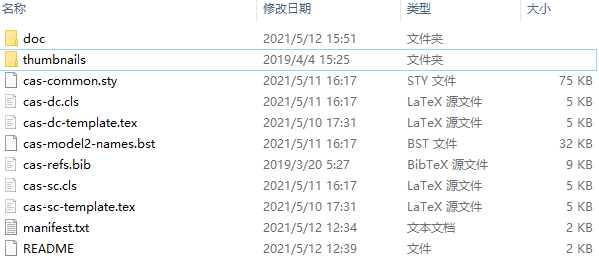
其中**cas-sc-template.tex**为单列模板**cas-dc-template.tex**为双列模板。
前言部分
有人可能会报错,根据我的经验大概率就是这里没有补全。将所有的**<>**补全后基本就不会报错了。
我是按照我自己顺序来的,没有完全搬用模板的顺序。我认为这样的顺序更清晰,也方便以后修改的时候能一下子找到位置。
% Main title of the paper
\title [mode = title]{Research on the evolutionary mechanism of information liquidity in learning-driven online social networks}
% Short title
\shorttitle{Research on the evolutionary mechanism of information liquidity in learning-driven online social networks}
\tnotemark[1]
\tnotetext[1]{This work was supported by the National Natural Science Foundation of China (NNSFC) (Nos. 62266030 and 61863025).}

% First author
\author[1]{Fuzhong Nian}[style=chinese]
% Short author
% \shortauthors{F. Nian, Z. Zhang \& Y. Qian}

% Corresponding author indication
\cormark[1]

% Corresponding author text
\cortext[1]{Corresponding author.}

% Email id of the first author
\ead{gdnfz@lut.edu.cn}

\author[1]{Zhen Zhang}[style=chinese]
\author[2]{Yinuo Qian}[style=chinese]

% Address/affiliation
\affiliation[1]{organization={School of Computer \& Communication},
  addressline={Lanzhou University of Technology},
  city={Lanzhou},
  citysep={}, % Uncomment if no comma needed between city and postcode
  postcode={730050},
  country={P. R. China}}

\affiliation[2]{organization={School of Control Science \& Engineering},
  addressline={Tiangong University},
  city={Tianjin},
  citysep={}, % Uncomment if no comma needed between city and postcode
  postcode={300387},
  country={P. R. China}}

% Here goes the abstract
\begin{abstract}
  This article focuses on the propagation process of social behaviors in social networks and proposes an influence-driven information propagation model to describe the propagation of social behaviors in social networks.
  Initially, it reveals the driving role of personal influence in information propagation and the relationship between personal influence and information propagation.

  Subsequently, the propagation mode of influence between individuals in the network is studied using propagation dynamics, elucidating the updating rules for interactions of influence between individuals.
  Ultimately, it explores the feedback loops and coupling mechanisms between information dissemination and influence propagation and how they mutually influence each other.
  Extensive experiments are conducted, citing real case studies to investigate the correlation between behavioral propagation and influence propagation in different events.
  The results indicate that the change of individual influence in the process of information propagation may change the information propagation, and may also change the influence in the process of information propagation, which proves the validity of the model.
\end{abstract}

% Research highlights
\begin{highlights}
  \item Revealed the driving role of personal influence in information propagation.
  \item Studied the propagation of influence among individuals in a network using the framework of propagation dynamics, elucidating the updating rules for interactions of influence between personnel.
  \item Explored the feedback loops and coupling mechanisms between information propagation and influence propagation, as well as how they mutually influence each other.
  % \item The new model is used to more comprehensively characterize the propagation process of social behavior in online social networks. Ultimately, extensive experiments and data comparisons are conducted, and the rationality of the model is validated.
\end{highlights}

% Keywords
% Each keyword is separated by \sep
\begin{keywords}
  Propagation dynamics\sep
  online social network\sep
  social behaviors\sep
  information propagation
\end{keywords}

\maketitle
交叉引用
这里有两套模板,其中一套模板里只有**cas-model2-names**这个样式。这个样式貌似默认是将引文部分按**A~Z**的顺序排列,不太符合要求,所以,我从另一套模板里复制出来的**elsarticle-num**。
%% Loading bibliography style file
% \bibliographystyle{model1-num-names}
\bibliographystyle{elsarticle-num}
% \bibliographystyle{cas-model2-names}
% Loading bibliography database
\bibliography{ref}这里改完默认还是没有序号,需要将前面三选一的选项选好。
\usepackage[numbers,sort&compress]{natbib}
%\usepackage[authoryear]{natbib}
% \usepackage[authoryear,longnamesfirst]{natbib}这里我还加了**sort&compress**,默认这个是没有的。****这个是让序号变成[1-3]这样,默认是[1,2,3]。看完了官方的全部文档,才找到这个选项。
其他修改
去掉页脚的 ORCID(s)
在下面这段代码最后添加 **\let\printorcid\relax**
\begin{document}
\let\WriteBookmarks\relax
\def\floatpagepagefraction{1}
\def\textpagefraction{.001}

\let\printorcid\relax    % 可去掉页面下方的ORCID(s)
将图片标题由 Figure 1: 变为 Fig. 1.
在导言区使用:
\usepackage{caption}
\captionsetup[figure]{labelfont={bf}, labelformat={default}, labelsep=period, name={Fig.}}其中,**labelsep=period**表示用英文句号分隔。
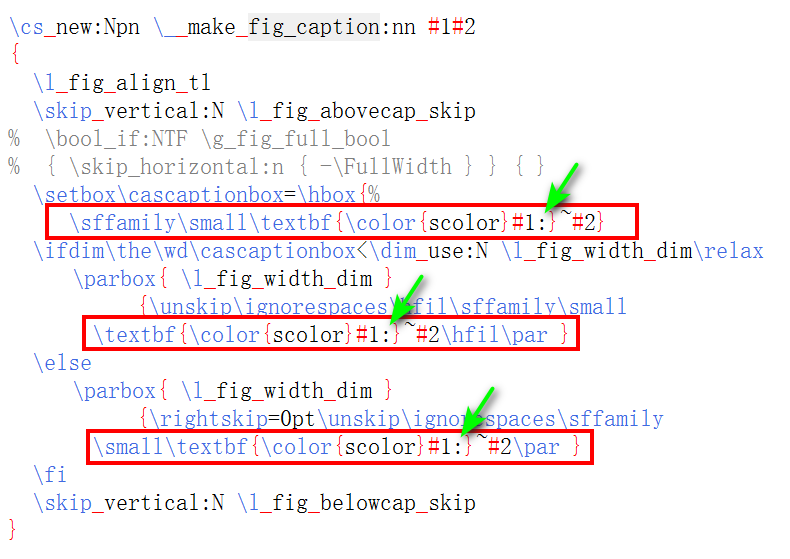
修改**cas-common.sty**文件:搜索**fig_caption**,将下面三个**:**替换为**.**即可
修改图 / 表格caption字体为Time New Roman
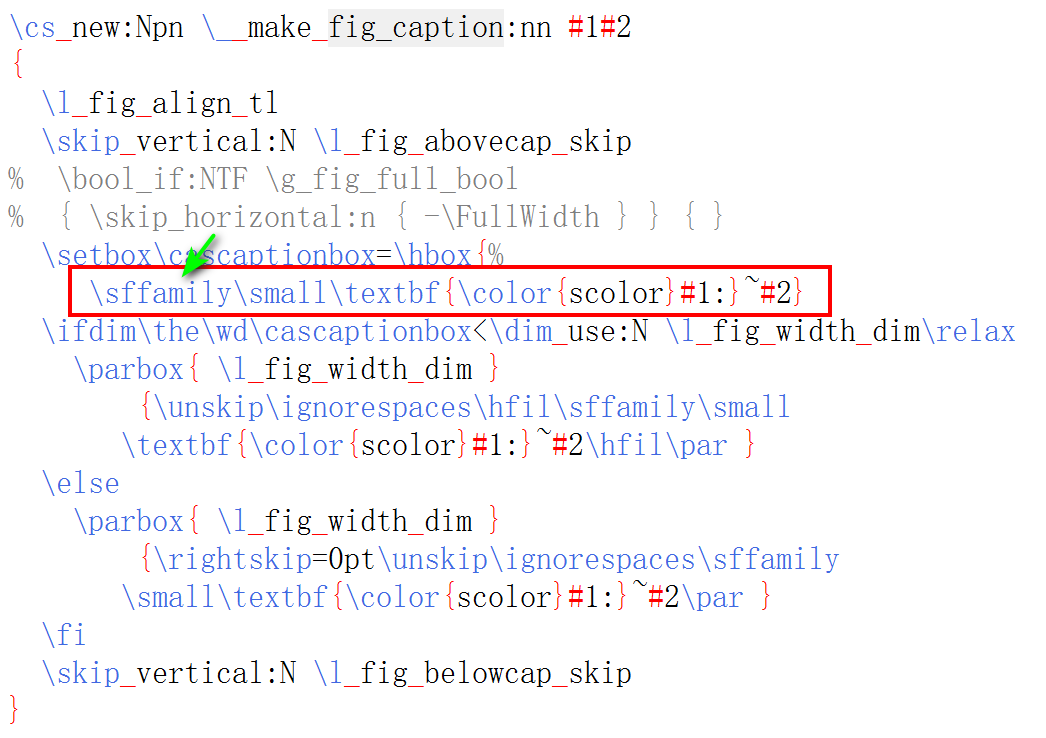
模板默认的图片/表格**caption**字体为字体族**\sffamily**
搜索关键字**fig_caption**和**tbl_caption**,将有关的**\sffamily**改为**\rmfamily**。
评论